The Federal Tax Authority (FTA) is the governing body for issuing all guidelines for Value-Added-Tax registration, return filing and other general VAT-related amendments in UAE. FTA has published a guide on Value Added Tax in Designated Zones. It aims to provide clarity on the way VAT is applicable to companies in the VAT-exempt Free Zone in UAE.
Many business investors want to know the way VAT is levied in Designated Free Zones of UAE.
What are Designated Zones?
Designated Zones are specific geographically fenced Free Trade Zones in UAE. These Special Zones are treated as being “outside” the UAE territory for Value Added Tax (VAT) purposes to facilitate smooth trade operations.
Not all Free Zones are categorized as Designated Zones. There are certain criteria to be met for Designated Free Zones for exemption of VAT.
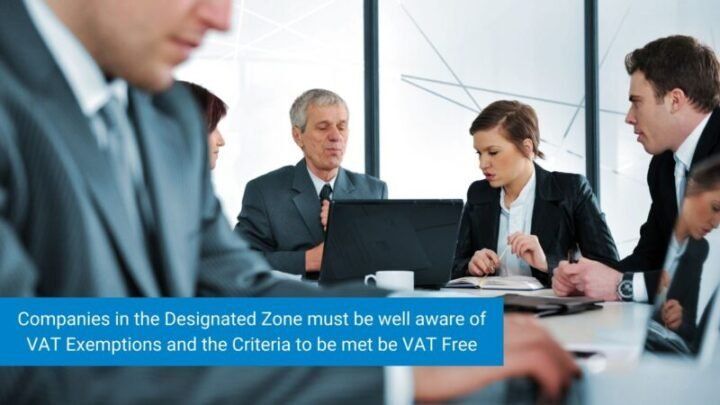
The VAT rules for Designated Free Zone are slightly complicated as there are a lot of case-to-case basis transactions across a company in a designated free zone with other companies in UAE and Overseas that may be VAT payable.
It is advisable to associate with an expert VAT Consultant to be aware of the VAT rules and compliance procedures to follow for recording every transaction in a company.
VAT Applicability while operating a Business in a Designated Zone
1. Delivering Services by a Mainland Supplier
If the service is offered in a Designated Zone, the place of supply is treated as UAE (similar to other Free zone and Mainland Companies based in UAE).
Hence, there are no special rules for any exemption of VAT for the services offered in the Designated Zones. It will be taxed according to the regular VAT rules as applicable to the transaction.
2. Delivering Goods within a Designated Zone
The case where both the supplier and consumer are in the Designated Zone will be generally out of the scope of VAT.
However, if the supply is to be consumed within the Designated Free Zones in the UAE and is not used for creating a new product or used for re-exports, then it is subjected to the standard 5% VAT.
3. Transfer of Goods into a Designated Zone
Following general rules will apply while a company transfer goods into a Designated Zone:
a) Overseas Goods Transfer from a Company in Designated Zone:
It is out of VAT scope as the goods are not reaching UAE but moving from one country to another. The company based in UAE is just facilitating global trade.
b) From Mainland UAE to Designated Zone:
It is treated as a taxable transaction as the movement of goods is within UAE and is not considered an export from UAE.
c) Transfer of goods between Designated Zones
It is treated out of the scope of VAT as the goods are not used or altered during the transfer between the designated zones. It is to be noted that the transfer of goods must be compliant with the UAE Customs Laws.
4. Import of Goods from Designated Zones
The movement of goods from a designated zone to the mainland is considered as an import into UAE. Hence it is taxable and seen as an import.
Designated Zones in UAE
As per the UAE Cabinet decision areas such as the Free Trade Zone of Khalifa Port (KEZAD), Jebel Ali Free Zone, and about 20 Free Zone in the UAE will be exempt from VAT. The scope of VAT in the UAE is large. For Designated Zones itself there are certain criteria to be fulfilled for the tax exemptions.
For example, the sale or lease of commercial or residential property located in any UAE Designated Zone is out of the scope of VAT. Similarly, there are many cases of VAT exemption as well as VAT Payable in UAE Designated Zones.
VAT on Selected Industries* – An Overview
| Industry Sector | Description | VAT Levied (%) |
|---|---|---|
| Telecommunications and Electronic Services | 5% | |
| Government Activities | Considered outside VAT Scope | |
| Not-for-profit Organization | Considered Outside VAT Scope | |
| Oil and Gas | Crude Oil & Natural Gas – | Zero |
| Other Oil & Gas Products including Petrol at the pump | 5% | |
| Property | Sale and rent of commercial buildings (not residential buildings) | 5% |
| First sale/rent of residential building after completion of construction | Zero | |
| Hotels, motels, and service accommodation | 5% | |
| Investment, gold, silver, platinum jewelry | 5% | |
| Transportation | Zero | |
| Financial Services | Exempted from VAT | |
| Education | Private and public school education and related goods and services | Zero |
| Education provided by private higher educational institutions and related goods and services | 5% | |
| School uniforms, stationery, electronic equipment’s, renting of the school ground, after-school activities fees, school trips for recreation, etc., | 5% | |
| Healthcare | preventive healthcare including vaccinations, healthcare services | Zero |
| Medicine, and medical equipment listed in Cabinet Decision | Zero | |
| Medicines, and medical equipment not listed in Cabinet Decision | 5% | |
| Other medical supplies | 5% | |
| Elective surgeries, cosmetic surgery, etc., | 5% | |
| Insurance and reinsurance | Insurance for Health, motor, property | 5% |
| Life Insurance and life reinsurance | Exempted from VAT | |
| Food and Beverages | 5% | |
| Others | Export of goods and services to the outside GCC region | Zero |
| Second-Hand Goods (Used cars sold by retailers, antiques, and collectors’ items) | 5% |
- The list is not exhaustive, please check the FTA website for more information
Applicability of Corporate Tax in Designated and Non-Designated Zone
The distinction between Designated Free Zones and Non-Designated Free Zones is critical, particularly for businesses involved in the trading and distribution of physical goods. While both zone types can legally achieve a 0% Corporate Tax rate, their classification changes which specific activities qualify for that tax exemption.
The Qualifying Freezone Person (QFZP) Status
Operating in a Free Zone does not automatically grant you a 0% tax rate. To pay 0% CT on your “Qualifying Income,” your business must meet the strict criteria to become a Qualifying Free Zone Person (QFZP):
Activities Qualifying for 0% CT in Designated and Non- Designated Zones
If your business is in either type of Free Zone, your revenue qualifies for the 0% rate if it comes from:
Transactions with other Free Zone Persons (provided the activity is not explicitly “excluded” like banking or insurance).
- Manufacturing of goods or materials.
- Processing of goods or materials.
- Trading of Qualifying Commodities.
- Holding of shares and other securities for investment purposes.
- Ownership, management and operation of Ships.
- Reinsurance services.
- Fund management services.
- Wealth and investment management services.
- Headquarter services to Related Parties.
- Treasury and financing services to Related Parties.
- Financing and leasing of Aircrafts.
- Distribution of goods or materials in or from a Designated Zone.
- Logistics services
The Designated Zone Advantage: Wholesale Trading
If you are registered in a Designated Zone, the “Distribution of Goods or Materials” to a corporate customer (wholesale) is considered a Qualifying Activity. This means a trading company in JAFZA can buy and sell physical cargo internationally or to other businesses and pay 0% Corporate Tax.
Conversely, a standard trading company in a Non-Designated Zone cannot claim the 0% rate on generic physical wholesale trade. Their trading profits will be applied with the standard 9% tax unless they alter their operations to 40% or more (e.g., adding value via “processing of goods”) or trade in recognized commodities (like gold, oil, or grains) on an approved exchange.
What is “Qualifying Income?”
Under the UAE Corporate Tax regime, Qualifying Income is the specific revenue earned by a Qualifying Free Zone Person (QFZP) that is eligible for the 0% Corporate Tax rate. Any revenue falling outside this definition is classified as non-qualifying and is subject to the standard 9% tax rate.
1: Income from Transactions with Other Free Zone Company
Revenue generated from business-to-business (B2B) transactions with other entities located inside a UAE Free Zone automatically counts as Qualifying Income.
- The Free Zone customer must be the “beneficial recipient” of the services or goods, meaning they truly receive and use them.
- This income is disqualified if it comes from an Excluded Activity (such as banking, insurance, or retail retail trade with individuals).
2. Income from “Qualifying Activities” with Non-Free Zone Company
If your client is in the UAE Mainland or anywhere internationally (Non-Free Zone Company), the income only qualifies for the 0% rate if it is derived from a specific list of Cabinet-Approved Qualifying Activities:
- Manufacturing of goods or materials.
- Processing of goods or materials.
- Trading of Qualifying Commodities.
- Holding of shares and other securities for investment purposes.
- Ownership, management and operation of Ships.
- Reinsurance services.
- Fund management services.
- Wealth and investment management services.
- Headquarter services to Related Parties.
- Treasury and financing services to Related Parties.
- Financing and leasing of Aircrafts.
- Distribution of goods or materials in or from a Designated Zone.
- Logistics services
3. Income from Qualifying Intellectual Property (IP)
Income derived from the ownership, licensing, or exploitation of Qualifying Intellectual Property (such as patents, copyrighted software, and legally protected assets) counts as Qualifying Income.
Note: Marketing-related IP assets like trademarks and brand names do not qualify and are taxed at 9%.
4: Income Covered by the De Minimis Rule
If your Free Zone business earns regular, non-qualifying income (e.g., standard consulting services provided to a UAE mainland company), it can still be taxed at 0% if the revenue stays below the De Minimis threshold.
The total non-qualifying revenue must not exceed the lower of: 5% of your total revenue in that financial year, OR AED 5 million
If this threshold is breached, the business will lose its QFZP status. Subsequently the Free Zone Company will face a 9% tax on all corporate profits for that year and the subsequent 4 years.
Under the UAE Corporate Tax (CT) regime, the distinction between Designated Free Zones and Non-Designated Free Zones is critical, particularly for businesses involved in the trading and distribution of physical goods.
While both zone types can legally achieve a 0% Corporate Tax rate, their classification changes which specific activities that qualify for that zero Corporate Tax status.
Compare Corporate Tax: Designated vs. Non-Designated Zones
The primary corporate tax differentiator centers on “The Distribution of Goods from a Designated Zone”, which is explicitly classified as a Qualifying Activity.
| Feature | Designated Free Zones (DFZ) | Non-Designated Free Zones |
|---|---|---|
| Physical Setup | Fenced areas with strict customs security (e.g., JAFZA, KEZAD, DAFZA, SAIF, HAMRIYAH, AJMAN, UAQ, RAKEZ). | Non-gated, urban, or service-focused zones (e.g., DMCC, DIFC, Meydan). |
| Corporate Tax Rate | 0% on Qualifying Income; 9% on Non-Qualifying Income. | 0% on Qualifying Income; 9% on Non-Qualifying Income. |
| Trading & Wholesale of Physical Goods | Eligible for 0% CT if goods are distributed to businesses globally or within Free Zones. | Taxed at 9% for standard physical trading unless it involves “Recognized Commodities”. |
| Providing Services | Eligible for 0% CT if the service falls under approved “Qualifying Activities”. | Eligible for 0% CT if the service falls under approved “Qualifying Activities”. |
| Transactions with UAE Mainland | 9% CT unless dealing with a mainland business for specific qualifying wholesale activities. | Standard 9% CT on most mainland-derived revenue. |
How is VAT Applicable in UAE Designated Zones for Service Companies?
As the place of supply of services is within UAE even though it is in a Designated Zone, the Federal Tax Authority states that the transaction is liable for the 5% standard VAT Charges.
The same is applied even if the service is rendered in other VAT exempted Free Zones in UAE, Free Zones, or on the mainland.
Thus in every scenario, UAE businesses must understand the process of applying VAT to their business activities and daily transactions. The impact assessment of VAT on their business entity is crucial for long-term sustainability.
VAT in Real Estate
VAT for real estate is dependent on whether the property is used for commercial or residential purposes. All commercial properties (sales/lease) are taxable at the standard VAT rate (i.e 5%).
However, residential properties are exempt from VAT. Hence, new properties that are bought by the investor will have zero VAT on them.
Business Sectors and VAT Treatment in UAE
There are various business sectors in UAE that are Zero rated or exempt from VAT in UAE. Under certain circumstances, these business activities are treated as free of VAT scope.
1. Zero-rated Sectors for VAT
The following areas are Zero-rated when it comes to VAT treatment in UAE.
- Exports of goods and services outside of the GCC
- Transportation-related supplies (International)
- Investment grade precious metals ( gold, silver -99% purity)
- Newly constructed residential properties ( first 3 years of construction)
- Supply for certain education services, goods, and services
- Supply of certain healthcare services
2. VAT-exempt sectors
There are a few categories of supplies that are VAT-exempt in the UAE such as:
- Financial Services
- Residential Properties
- Bare Land
- Local Passenger Transport
3. Government Entities and VAT Treatment
Supplies made by government entities are subject to VAT. This ensures no unfair advantage is leveraged by government entities when compared to private businesses.
There are certain supplies made by the government that is excluded from the scope of VAT especially when the entity is the sole provider of such supplies and there is no competition in the field.
Connect with our VAT Experts to know more about VAT registration, VAT Return filing, and any VAT-related queries!